
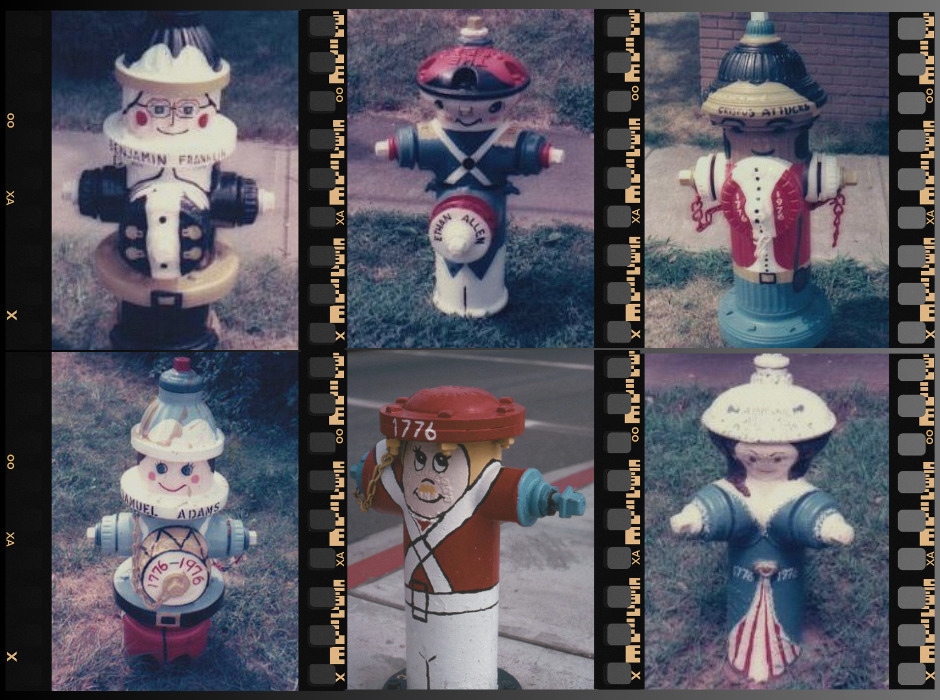
As we start to gear up for the semiquincentennial of our nation’s birth (that’s 250 years for you non-Latin scholars) my mind wanders back 50 years to the bicentennial celebration in 1976.
I remember a lot about the bicentennial celebration. I remember the flotilla of tall-masted ships that sailed into New York Harbor. I remember the dedication of our own Bicentennial Park in downtown Columbus. Living in German Village at the time I was close enough to ride my bicycle down to it and to see them turn on the fountains there. I remember reading a lot of history about the founding of our country, the signing of the Declaration of Independence.
What I remember the most, however, are the fire hydrants.
To make sure that I was not imagining this phenomenon from 1976 I did check the internet. I found an article by Christopher and Sharon Leahy who remembered the same thing:
“In 1976, I stood on the corner of Hundred Oaks Avenue and South Eugene Street in Baton Rouge, waiting for my grammar-school bus.”
“Beside me stood a fire hydrant painted like Uncle Sam—bright, unmistakable, and cheerful.”
“It wasn’t a monument or part of a parade route. It didn’t come with a plaque.
It was simply there, quietly marking America’s 200th birthday in the middle of an ordinary neighborhood.”
“At the time, I didn’t think of it as history. It was just part of the landscape of childhood. Only later did I realize how many towns across the country were doing the same thing…”
“The American Bicentennial did not unfold solely in Washington, D.C., or on television screens. It happened in school hallways, apartment lobbies, neighborhood streets—and, remarkably often, on fire hydrants.”
I was in college at the time. I was not an artist, nor was I involved in any civic pride activities. So to me, back in 1976, the painted hydrants just seemed to sprout up like dandelions in the spring.
They didn’t just become Uncle Sam. They became George Washington. And Martha. Ben Franklin. John Adams. Continental soldiers.
But whose idea was it? According to another source, “There was no national program. There was no committee.” Suddenly, ordinary yellow, unobtrusive hydrants started popping up as red, white and blue patriots across the country. And remember, this was in the days before Tik-Tok and Instagram.
But they were indeed everywhere. Did anyone ask permission? Did anyone try to stop them? You couldn’t go down a street without seeing them standing guard on curbs.
Time soon faded them, although I remember that some hung for years. Whatever kind of paint was used was awfully resilient to the weather.
The patriotic fire hydrants were a simple, some say silly, mass movement. But it showed pride in our country. It helped to heal our wounds from Vietnam and Watergate. I am sure it was a blast for the people who painted them. It made driving, or in my case bicycling, down the street a lot more interesting.
We could use more of this, don’t you think?
Jim Silcott